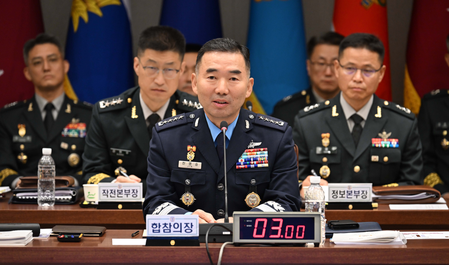
Seoul, Oct 8 (IANS) South Korea’s top military commander said Thursday he had not thought of the recent mine blast near the inter-Korean border as anything other than a “provocation” by North Korea, while vowing to review response measures.
Joint Chiefs of Staff (JCS) Chairman Gen. Jin Yong-sung made the remarks as some opposition lawmakers have raised issues with the South Korean military for allegedly refraining from depicting the Sept. 21 blast as a “provocation” by the North.
“There was not a single moment when I thought it was anything other than a provocation when one of my men was seriously injured,” Jin said during a parliamentary audit.
“But I had not paid close attention to the fact that the term ‘provocation’ was not included in the announcement,” he said when asked why the military had left out the term during Monday’s briefing, Yonhap News Agency reported.
The JCS concluded its joint investigation with the U.N. Command into the mine blast on Monday, confirming its preliminary findings that resin antipersonnel mines deliberately planted by Pyongyang south of the Military Demarcation Line (MDL) were the cause of the blast. The explosion left three South Korean soldiers injured, two of them seriously.
On whether he deems the mine-removal operation conducted by South Korean troops at the blast site as a “corresponding” response, Jin said he thought the operation was “highly significant” and succeeded in expressing the resolve of the South Korean military.
“At the very least, we need to eliminate ourselves the threat that caused serious injuries to our comrades near the MDL,” he said. “I think it is highly significant that we were able to carry out a successful operation with a unit that acts on orders from its commander, thereby demonstrating and following through on our resolve.”
Asked if the military was planning other response measures, Jin said he would continue to review the necessary steps, without elaborating.
The South Korean military launched an operation Monday to remove any remaining land mines planted by North Korea at the blast site, in what marks the first such mission inside the buffer zone between the two Koreas.
When asked about the status of US intelligence sharing on North Korea-related matters, the JCS chairman stressed that the partial restrictions on information sharing do not hinder the military’s readiness posture.
“While it is true that information sharing has not been fully restored, there are no problems or limitations in carrying out our missions related to North Korea’s nuclear and missile programs,” he said.
“However, I think it is best that this situation is resolved swiftly, and (we are) working toward that end,” he added.
Washington has partially limited Seoul’s access to intelligence on North Korea-related technology since April in protest against the unification minister’s disclosure of information on one of the North’s nuclear facilities.
Unification Minister Chung Dong-young referred to North Korea’s Kusong region as one of the sites hosting a uranium enrichment facility at a parliamentary session in March, in addition to the previously reported sites in Yongbyon and Kangson.
The restricted intelligence is presumed to be related to North Korea’s technology collected via satellites.
Jin said South Korea and the U.S. will conduct six of the seven live drills that were postponed in August following U.S. President Donald Trump’s order to scale back the allies’ annual Ulchi Freedom Shield (UFS) exercise.
“Six of the seven (exercises) that were postponed have been rescheduled and will start either this week or next,” he said in response to a lawmaker’s question about the drills.
The UFS is one of the two major theatre-level combined exercises Seoul and Washington conduct annually to train for contingencies against North Korea. It was cut short from 11 days to five, with field manoeuvres reduced by half to seven.
Trump cited the cost burden for the exercise and his good relationship with the North’s leader Kim Jong-un, saying the drills could send an “inappropriate and hostile” message to Pyongyang.
Meanwhile, the South Korean military vowed to strengthen its readiness posture to deter further provocations by North Korea following the recent mine blast.
It also pledged to respond “sternly” to the damage suffered by South Korean troops, including through both physical and nonphysical means.
In the mid-term, the military plans to strengthen the capabilities needed to maintain the initiative in operations in the Demilitarised Zone (DMZ), including by minimising surveillance blind spots.
The JCS also said it will accelerate efforts to transition the surveillance systems at general outposts in frontline units to artificial intelligence (AI) and advanced technology-driven systems.
–IANS
ksk/as