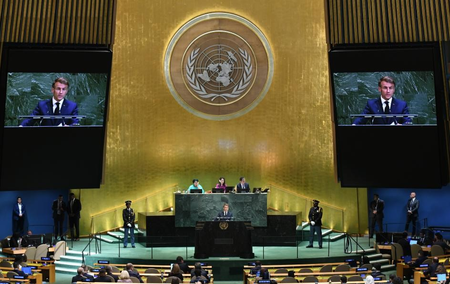
United Nations, Sep 27 (IANS) Selective enforcement of international law is weakening the global order and eroding confidence in institutions created to prevent war and hold governments accountable, world leaders have told the UN General Assembly.
Speakers from Europe, the Middle East, Africa and the Caribbean said rules could not remain credible if they were enforced against some countries but ignored when politically powerful states or their allies were involved.
French President Emmanuel Macron framed the choice as one between international justice and a return to unrestricted power.
“There cannot be peace without justice,” Macron said.
He asked whether countries wanted a civilised international society or a return to “the law of the jungle”. France supported the International Court of Justice and opposed what Macron described as a new order of impunity.
Qatar’s Amir Sheikh Tamim bin Hamad Al Thani said there could be no just international order while Palestine remained a blind spot.
“The law must apply equally to all,” he said.
Jordan’s King Abdullah II said the international community had mechanisms including sanctions, asset freezes, embargoes and diplomatic isolation but had not used them consistently in addressing Israel’s conduct.
“Resolutions end where they begin, on paper,” he said.
Several speakers linked the debate over Gaza with other conflicts and argued that inconsistent responses damaged the credibility of the entire multilateral system.
Ghanaian President John Mahama warned of “a dangerous drift towards unilateralism, lawlessness and the erosion of multilateral norms”.
He supported a two-state solution, condemned acts of terrorism by Hamas and urged the international community to stop obscuring civilian suffering through diplomatic language.
Guyana President Irfaan Ali said climate disasters, food insecurity, inequality and conflict were all serious crises, but the weakening of multilateralism itself could be the most troubling.
Slovenian Prime Minister Janez Janša proposed an independent mechanism to compare major crises with the international response to them.
The review would examine the scale, duration and severity of emergencies alongside the diplomatic, humanitarian and legal action taken. Its purpose would not be to dictate political conclusions but to reveal patterns of selectivity, he said.
The Netherlands defended the International Criminal Court against attempts to weaken it.
Prime Minister Rob Jetten said the court was founded on the legacy of the Nuremberg and Tokyo trials and called on middle powers to help protect international accountability.
Prime Minister Benjamin Netanyahu of Israel said attacks against Israelis received insufficient attention while international media and social platforms focused heavily on alleged settler violence.
He presented Israel’s military operations as a response to the October 7 Hamas attack and threats from Iran.
Palestinian President Mahmoud Abbas, speaking by recorded video after his delegation was denied visas, said the conflict threatened the existence of the Palestinian people and the possibility of a two-state solution.
Switzerland urged governments to protect international law. President Guy Parmelin said engagement did not require opposing sides to become alike, but it could provide a route back to negotiation.
The International Court of Justice resolves legal disputes between states, while the International Criminal Court can prosecute individuals accused of genocide, war crimes and crimes against humanity. Their authority, however, depends heavily on recognition, cooperation and compliance by governments.
India has consistently supported the UN Charter, peaceful settlement of disputes and respect for sovereignty. It has also argued that international institutions must become more representative and that rules should be applied consistently if the multilateral system is to retain the confidence of the Global South.
–IANS
lkj/rs