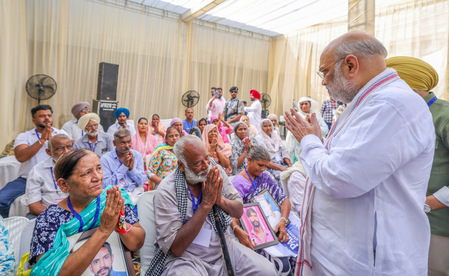
New Delhi, Oct 19 (IANS) Union Home Minister Amit Shah, who has declared a war on narcotics, is set to meet the families of those killed for speaking out against the growing menace of ‘chitta’, a synthetic drug that has become a major concern in Punjab.
The meeting assumes significance amid the drug’s alarming spread across the state, where its delivery network is said to be so widespread that chitta can reach consumers faster than food.
The drug menace is likely to emerge as a major point of contention between the Bharatiya Janata Party (BJP) and Punjab’s ruling Aam Aadmi Party (AAP) ahead of the 2027 Assembly elections.
Law enforcement agencies battling drug trafficking across the country view Punjab as a particularly challenging case, given the scale and persistence of the narcotics problem in the state.
An official said the rising consumption of ‘chitta’, which means white in Punjabi, was having a devastating impact not only on addicts and their families but also on the state’s security situation.
Studies indicate that young people addicted to the drug spend an average of Rs 1,400 to Rs 2,000 a day on it. Many of them are unemployed and lack the means to sustain this expenditure, pushing some to seek money through other means.
“They are becoming the immediate targets of both gangsters and ISI-backed elements,” the official said.
Young people struggling with drug addiction are being identified in large numbers and allegedly exploited by criminal networks. They are reportedly recruited to retrieve drug consignments dropped by drones and deliver them to peddlers within the state.
Some are also being tasked with transporting arms and ammunition smuggled into Punjab using drones. In certain cases, these youths are allegedly being recruited to carry out targeted killings.
“This would ensure that the state remains on the boil and this could well pave the way for the revival of the Khalistan movement in Punjab,” the official said.
‘Chitta’ is a potent, adulterated opioid mixture derived from heroin that is smuggled into Punjab through the Golden Crescent route, which includes Pakistan and Afghanistan, before being sold in local markets.
Data indicates that thousands of young people in Punjab are addicted to the drug, with a significant number belonging to the 15-25 age group.
Another official said gangsters and pro-Khalistan groups were exploiting drug addicts to carry out illegal activities. The official added that drug addiction had also been accompanied by a rise in burglaries, domestic abuse and gangster-related activities in the state.
Officials say to beat the drug menace, the central and state agencies need to be on the same page.
While there have been major drug busts in Punjab, when it comes to ‘chitta,’ there is still a long way to go, the official said.
An Intelligence Bureau official said there was a growing trend in Punjab of targeting individuals who speak out against the drug menace. Several people have reportedly been targeted in a series of ‘shoot the messenger’ incidents for raising their voices against the spread of ‘chitta’.
“This is making the fight against the drug menace a major challenge. When people who speak out are killed, it hampers the operations of law enforcement agencies as their sources begin to dry up. Without reliable ground-level sources, intelligence agencies find it difficult to function, as the flow of vital information from the ground is disrupted,” the official said.
A report by ‘The Reporters’ Collective’ has documented nearly 50 instances of media censorship in Punjab. These include FIRs, police raids, copyright strikes, and disruptions of news coverage critical of the system.
The year 2026 has seen a spike in incidents where the messenger has been targeted. Maninderjeet Singh Sidhu had exposed a local dealer in one of his videos, which discussed the rising menace of drugs. Sukhjinder Singh alias Chinda, the local dealer, died by suicide, following which an abetment to suicide case was filed against Sidhu.
Parminder Singh Jhotta, a prominent anti-drug activist from Mansa in Punjab, was shot dead by unidentified assailants.
Bikramjit Singh, a 40-year-old anti-drug activist, was killed in Mari Panwan village.
In another incident, Gulzar Singh had asked Punjab Finance Minister Harpal Singh Cheema at a public meeting why ‘chitta’ was so readily available in his village, Toor Banjara. The following day, he was summoned by the village panchayat and asked to apologise for questioning the minister. Humiliated by the episode, Singh died by suicide.
Amit Shah accused the Punjab government of pushing the state deeper into the drug crisis, saying it had “left no stone unturned” in doing so. The Union Home Minister also asserted that attempts to silence those who speak out against the drug menace would never succeed.
The statement came in the wake of the Union Home Ministry seeking a report from the Chief Secretary of Punjab about the three drug-related deaths.
Officials say that this is turning into a nightmare for the agencies and a big boon for those involved in the drug trade. Punjab has had a violent history, and it is a well-known fact that the ISI is pushing a gangster-terror network in the state to revive the Khalistan movement.
The Inter-Services Intelligence (ISI) would continue to exploit the situation and recruit more addicts so that they can be involved in acts of terror, smuggling, and distribution of arms and ammunition.
There have been several intelligence reports of how the ISI is trying to incite tensions in Punjab and also push the state to the brink ahead of the elections scheduled for 2027.
The agencies would need to tread carefully and, more importantly, coordinate to beat this menace, an official said.
–IANS
vn/snj/skp