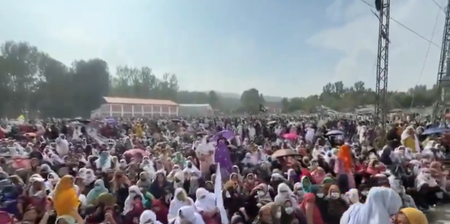
New Delhi, Oct 16 (IANS) Pakistan is witnessing what amounts to an undeclared state of emergency, with violent protests sweeping Khyber Pakhtunkhwa (KP), Balochistan and Pakistan-occupied Kashmir (PoK).
The unrest across the three regions has triggered a series of crackdowns, as the Pakistani establishment attempts to downplay the scale of the protests and the developments unfolding on the ground.
While Balochistan and PoK have witnessed prolonged unrest, attention has now shifted to KP, where emergency measures and Governor’s rule have been imposed. Protests have spread across the region, but only a fraction of the developments are reaching the public domain, amid fresh restrictions on press freedom in Pakistan.
In addition to curbs on the media, Pakistan has also restricted access to international monitoring groups, while also placing local human rights groups under the terror watch list. To avoid international scrutiny, Islamabad has also reached out to pressure groups abroad to keep the narrative under tight control.
The Pakistan Electronic Media Regulatory Authority (PEMRA) has directed media channels to refrain from live coverage of the ongoing protests and has also sought to restrict coverage of the frequent riots and blasts reported in KP and Balochistan.
The situation in PoK is no different. Protests that have continued for several months have received scant coverage in the Pakistani media.
An official said that there is hardly anything that comes out of these regions. “The Pakistani establishment runs a pretty tight ship when it comes to information from these regions, which have been on the boil for long,” the official said.
The media blackouts and the curbs on human rights groups from visiting these regions are, in fact, helping the Pakistani establishment carry out extrajudicial killings and forced disappearances, the official said.
“Whatever information that is coming out of these regions is thanks to the social media posts of insurgent groups and the activists in the region,” the official also said.
Another official said that media coverage of the protests is subject to strict scrutiny.
Any footage or information that reaches the media from these regions is subjected to extensive scrutiny by government agencies. Even the limited footage permitted for broadcast is not aired in real time.
There are clear instructions to delay live feeds so that people in Pakistan do not get a true picture of what is happening on the ground, the official said.
An Intelligence Bureau official said that while social media posts by people on the ground were bringing some information to light, the flow of information remained inconsistent.
Internet services remain largely shut down, while social media posts about the ongoing situation in the region are subject to intense scrutiny.
Further, the rules for international monitoring organisations, UN experts and foreign journalists seeking to visit these regions are heavily restricted. Even if security clearance requirements such as a No Objection Certificate (NOC) are met, these persons are taken on guided tours across the region so that Pakistan can show only what they want to see.
Further, the establishment is also targeting groups such as the Human Rights Commission of Pakistan, Baloch Yakjehti Committee (BYC), and the Pashtun Tahafuz Movement (PTM). These organisations are placed on terror watch lists, making it extremely hard for them to function. Groups such as these have been reporting the extrajudicial killings, and the establishment has managed to suppress this successfully.
Scores of activists have been detained illegally for several months and tortured in jails, officials say.
Pakistan wants to keep the incidents in these regions under wraps as it fears international condemnation. The European Commission has warned that human rights abuses, lack of accountability and military trials could threaten Pakistan’s trade preferences.
While ensuring the maximum curbs in these regions, Pakistan has also reached out to its pressure groups in countries such as the United States to ensure that matters are kept under wraps.
These pressure groups, which have primarily been tasked with pushing narratives against India on Jammu and Kashmir, have also been directed to ensure that information about the unrest in Balochistan, Khyber Pakhtunkhwa (KP) and Pakistan-occupied Kashmir (PoK) does not reach the outside world.
The last thing Pakistan wants now is international attention, especially at a time when its economy is in tatters, an official said.
–IANS
vn/snj/skp