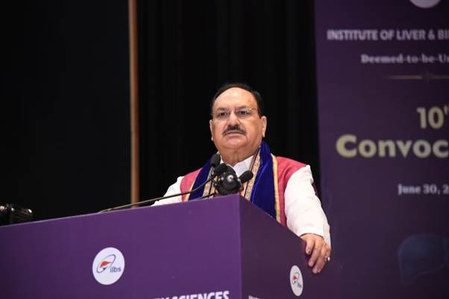
New Delhi, June 30 (IANS) Union Health and Family Welfare Minister Jagat Prakash Nadda said on Tuesday that under the visionary leadership of Prime Minister Narendra Modi, the government has strengthened medical education by focusing on “hardware” and “software,” or infrastructure and an enabling ecosystem.
Addressing the 10th Convocation of the Institute of Liver and Biliary Sciences (ILBS) in New Delhi, Nadda said that while the “hardware” comprises world-class infrastructure, medical institutions and healthcare facilities, the “software” represents the enabling ecosystem, policy framework and academic environment that empower students, researchers and healthcare professionals to excel.
He remarked that the true strength of a nation’s healthcare system lies not merely in creating institutions, but in building an ecosystem where excellence can flourish.
Underscoring the impact of policy reforms, Nadda stated that students must appreciate how visionary policymaking and a supportive ecosystem together create lasting change.
He noted that at the end of the twentieth century, India had only one AIIMS. During the tenure of former Prime Minister Atal Bihari Vajpayee, six more AIIMS were approved. Since then, under the leadership of Prime Minister Narendra Modi, 16 new AIIMS have been operationalized, bringing the total to 23.
The Union Minister highlighted the unprecedented expansion of medical education infrastructure across the country, pointing out that the number of medical colleges has increased from 387 to 818.
Similarly, undergraduate medical seats have risen from around 50,000 to over 1.20 lakh, he said.
Referring to the Prime Minister’s announcement from the Red Fort, Nadda said that the Government has set a target of creating an additional 75,000 undergraduate medical seats over the next five years, and that nearly 25,000 seats have already been added, reflecting steady progress towards achieving this objective.
He stated that postgraduate medical seats have expanded from approximately 30,000 to over 80,000, significantly strengthening the availability of specialist doctors in the country.
Nadda stated that to provide quality healthcare to nearly 1.5 billion people, it is essential to strengthen the very foundation of the healthcare delivery system.
In this context, he highlighted the establishment of more than 1.85 lakh Ayushman Arogya Mandirs across the country, describing them as the first point of contact for citizens seeking healthcare services.
He said these centres have transformed the country’s approach towards comprehensive primary healthcare by placing equal emphasis on preventive, promotive, curative and rehabilitative care.
–IANS
rch/dan