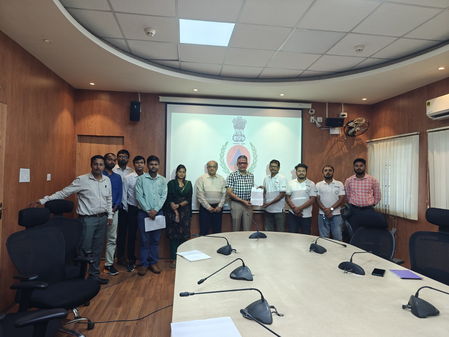
Kolkata, Oct 9 (IANS) Taking a cue from how communication links were disrupted after the Nepal flash floods, the West Bengal Disaster Management and Civil Defence Department signed a Memorandum of Understanding (MoU) with the West Bengal Radio Club (WBRC) on Friday.
The WBRC is an organisation of amateur radio operators. Apart from communicating with people across the world, its members help in maintaining radio links during major calamities when mobile networks stop functioning. They are trained to set up communication networks with the bare minimum supplies.
“During cyclones, floods and earthquakes, when conventional communication links get cut off, the HAMs play a crucial role in ensuring co-ordination between various teams engaged in rescue and relief efforts. All our members have the necessary licences that allow them to operate two-way radio sets. When the need arises, they can set up radio stations within a short period of time and restore communications,” Ambarish Nag Biswas, secretary, WBRC, said.
The organisation also runs the Indian Academy of Communication and Disaster Management. Several civil defence volunteers from across the state have already received training there and obtained licences to operate amateur radios.
Under the MoU, more people will be trained, and experts will monitor their progress in setting up radio stations in remote areas.
“During natural disasters, the HAMs work as an important link between the wireless sets operated by various agencies. This aids in keeping all teams abreast of developments. The signing of the MoU was an extremely proud moment for us. While we have been doing this for a long time, the amateur radio operators are now officially designated as lifesavers,” Subir Dutta, president, WBRC, said.
Among those present during the signing of the agreement were IPS officers Sanjay Singh and Debashis Sarkar from the Civil Defence Department and top functionaries of WBRC.
The activities of the organisation first came to light during the 1999 Odisha Super Cyclone, when its members reached remote areas, fixed temporary antennae to treetops and restored communication links.
More recently, WBRC members rushed to Nepal after the 2015 earthquake devastated parts of the country. They again helped restore vital communication links between various agencies engaged in rescue and relief.
A team was also ready to travel to Nepal this year after the devastating flash floods, but did not receive permission from the government of that country.
“We have always been called in by the West Bengal government during cyclones. We have moved to remote areas and maintained communication links with agencies like the National Disaster Response Force (NDRF). This aided vital rescue efforts,” Nag Biswas said.
Teams from the WBRC have also operated at Sagar Island during the Gangasagar Mela since the time when there was no mobile connectivity there. The HAMs continue to operate during the annual event even now, helping people in distress.
Of late, several educational institutions have also got in touch with WBRC to train college students in wireless communication. The members train students on how to obtain licences and operate their own radio stations.
“We have endeavoured to turn a hobby into a life-saving exercise. Today, our efforts are recognised across the country,” Nag Biswas added.
–IANS
jg/dan