New Delhi, Oct 8 (IANS) Climate change is not only an environmental crisis, but also a crisis of livelihoods, access, representation and power, leading experts have emphasised.
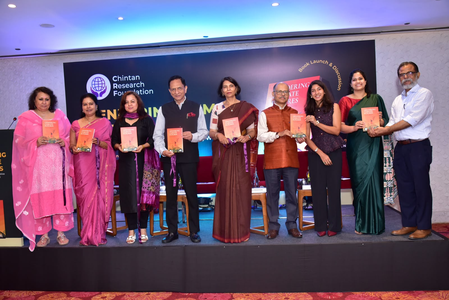
Chintan Research Foundation (CRF) launched its new edited volume, titled ‘Gendering Climate Futures: Power, Finance, and Justice in a Warming World,’ in the national capital.
Shishir Priyadarshi, President, CRF, highlighted the disproportionate impacts on women, including livelihood and education disruptions, and underscored the importance of land ownership in enabling women’s access to credit and climate-resilient investments.
He stressed that gender must move from the periphery to the centre of climate policy, shaping how vulnerability, adaptation, and justice are understood.
Edited by Kalyani Shukla and Sandra Kurian, the volume examines the intersections of gender and climate change across questions of vulnerability, access, agency, finance and participation in the just transition, with a particular focus on South Asia and India.
It brings together research drawing on diverse approaches including policy analysis, case studies, feminist political ecology, grassroots perspectives and quantitative research.
The volume, now available for purchase online, was formally unveiled in the presence of editors, contributors and panellists, followed by a panel discussion.
The discussion highlighted the unequal impacts of climate change on women, while the panellists underscored the importance of improving their access to land, finance, technology, data and social protection.
It also examined the institutional barriers to mainstreaming gender in climate and employment policies, with coordination across departments and stakeholders emerging as a key challenge.
Greater availability of gender-disaggregated data was identified as essential for understanding the economic and social impacts of climate change and informing responsive policies, according to the CRF.
The panellists further stressed the importance of integrating gender considerations at the design stage of climate and development programmes, rather than treating them as an afterthought, and of strengthening communication approaches to translate complex research and data into accessible, relevant and actionable messages.
The discussion was moderated by Dr Mini Govindan, Senior Fellow, TERI, and brought together Arti Ahuja, IAS (Retd), Former Secretary, Labour and Employment, Government of India; Dr Nikhil Raj, Development Economist and Director, Sustainable Outcomes; Pinky Pradhan, Communications and Media Specialist, UNFPA; and Dr Aditi Kapoor, Gender Consultant, Asian Development Bank.
–IANS
na/