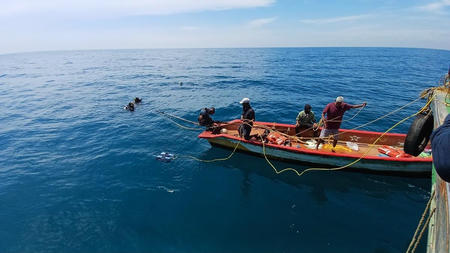
Chennai, Sep 21 (IANS) Tamil Nadu’s efforts to uncover its ancient maritime history are set to gain momentum, with the State Archaeology Department preparing to submit reports on underwater surveys at Korkai and Poompuhar to the government by February next year.
The documents will include an analysis of the sonar survey conducted off the Korkai-Azhagankulam coast and findings from the ongoing third phase of underwater exploration at Poompuhar in Mayiladuthurai district.
After the Korkai report is examined and the necessary clearances are secured, archaeologists are expected to undertake diving operations to verify possible structures and artefacts identified beneath the seabed.
The exercise could provide crucial evidence about the location and nature of the ancient Pandya port. A side-scan sonar survey has already been completed in the region.
Archaeologists and technical experts are now collating and interpreting the data gathered during the underwater reconnaissance.
The geographical identification survey at Korkai was conducted about two years ago in association with the Indian Maritime University. It employed advanced equipment, including multi-beam echo sounders, side-scan sonar systems and sub-bottom profilers, to locate possible archaeological features underwater.
Officials said sonar images alone were insufficient to establish whether the detected anomalies represented remains of the ancient port. Diving exploration is required to determine if the formations include shipwrecks, structures or other archaeological material buried beneath the seabed.
Poompuhar was prioritised for immediate exploration after the preliminary survey indicated stronger prospects there. The current phase is also intended to improve photographic and visual documentation of underwater discoveries.
Earlier explorations at Poompuhar had uncovered ceramics and shipwrecks, but only limited photographic records were available. The latest operation is expected to create more comprehensive documentation. About 10 per cent of the overall project has been completed.
Korkai was among the most prominent ports of the Sangam era and served as an important maritime centre of the Pandya kingdom. It maintained trade connections with the Roman Empire and other overseas regions and was widely known for its pearl fishery.
Excavations conducted in 1968-69 uncovered artefacts, conch-shell cutting workshops and facilities used to process pearl oysters. Terracotta lamps and sharp bone implements associated with weaving and hunting were also recovered.
Archaeologists believe underwater investigation could complement these discoveries and reveal submerged material linked to Korkai’s harbour. Such evidence could offer fresh insights into ancient Tamil maritime trade, navigation and commercial links across the Indian Ocean.
–IANS
aal/skp