Hyderabad, July 1 (IANS) Telangana Chief Minister A. Revanth Reddy on Wednesday directed officials to focus on revenue mobilisation to achieve targets in line with the state budget.
He directed that leakages related to commercial taxes, excise, mining, and other departments be completely curbed.
He said a chasing cell should be set up for revenue mobilisation.
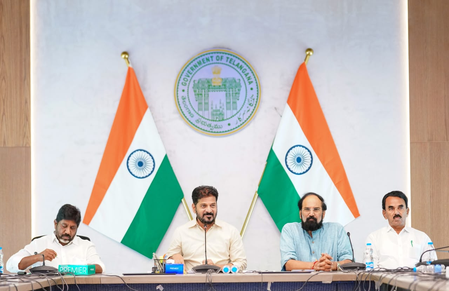
The Chief Minister reviewed state government revenue mobilisation in a high-level meeting held at MCR HRD.
According to the Chief Minister’s Office (CMO), he issued several key directives to officials on increasing revenue.
He said special attention should be focused on revenue mobilisation from Hyderabad Metropolitan Development Authority (HMDA) and Telangana Industrial Infrastructure Corporation (TGIIC).
He made it clear to officials that negligence in revenue enhancement and fund mobilisation must be avoided.
He said that to perform at the expected level, departments should further improve their capacity on a departmental basis.
He instructed that budgets be prepared department-wise in accordance with pending projects and other works.
He told officials that land acquisition should be taken as the top priority in connection with projects.
He clarified that the budget proposed by the government should not be imaginary and that budgeting should be done based on reality.
He said the government is ready to provide all kinds of support needed by the respective departments.
At another meeting, Chief Minister Revanth Reddy proposed integration of traffic signals across Hyderabad.
He called for adopting technology to operate the signals effectively for hassle-free traffic management.
The Chief Minister emphasised the integration of the system with AI to regulate traffic flow during rains.
The heads of the two companies briefed the Chief Minister about the Hyderabad traffic pilot project and how technology could be utilised for immediate solutions to the challenges facing urban areas.
They also outlined their vision for “Next Generation Intelligent Infrastructure” and solutions based on “Physical Intelligence,” which are essential for future generations.
They explained how physical intelligence, sensors and robotics could help develop safe, efficient, and responsive urban transportation systems.
The meeting highlighted the potential for creating “Cognitive Cities”, urban environments capable of tasks such as adjusting traffic signal systems based on real-time congestion, detecting and repairing water leaks in advance, managing power supply according to demand, and clearing paths for ambulances and fire tenders during emergencies.
Both organisations highlighted emerging technologies to address the needs of rapidly growing cities by enhancing government operational efficiency, improving citizen services, and facilitating data-driven infrastructure planning.
–IANS
ms/dan