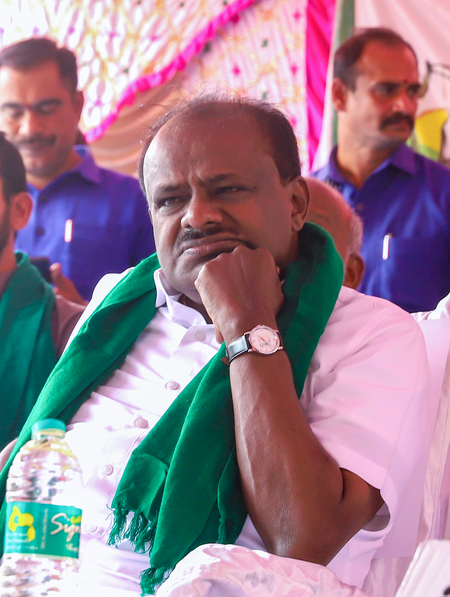
Hassan (Karnataka), July 29 (IANS) Union Minister H.D. Kumaraswamy on Wednesday termed the Cauvery Water Regulation Committee’s (CWRC) directive asking Karnataka to release 3,500 cusecs of water daily to Tamil Nadu for 15 days as “unscientific” and described it as a “death warrant” for the state in the prevailing circumstances.
Speaking to reporters at Haradanahalli in Hassan district, Kumaraswamy said Karnataka was facing drought-like conditions, with inadequate rainfall and depleted reservoir levels, making it difficult to meet even the state’s own requirements.
“The CWRC’s order is a death warrant for Karnataka. On one hand, the state is experiencing drought conditions, and on the other, reservoirs have not filled due to deficient rainfall. We are struggling to provide water even to our farmers. Drinking water needs must take priority. In such a difficult situation, directing Karnataka to release water to a neighbouring state is unscientific,” he said.
The Union Minister cautioned that the situation could worsen if rainfall remains deficient in the coming weeks and called for a united fight against the order.
“If there is no rainfall in the coming days, the crisis will deepen further. Everyone will have to come together and oppose this order. Farmers and various organisations have already begun protesting. Tamil Nadu is exerting pressure at a time when Karnataka itself does not have sufficient water,” he said.
Kumaraswamy said Karnataka must effectively communicate the ground realities to the Cauvery authorities, though he refrained from blaming the state’s legal team and officials for their handling of the case.
“I cannot say that our legal experts and officials failed to present the case properly. However, we need to introspect on how effectively we have managed our water resources,” he said.
The former Karnataka Chief Minister also criticized successive governments for failing to adequately store water during years of abundant rainfall.
“Last year, our reservoirs filled up three times. That was the time to take precautionary measures and fill lakes and tanks across the state. Had the Irrigation Department and the government acted in time, more water could have been retained. Instead, water was allowed to flow out without utilizing it to replenish lakes,” he said.
He noted that Tamil Nadu, too, had failed to optimally utilize surplus rainwater and had allowed excess water to flow into the sea.
“Tamil Nadu also did not make full use of the additional water received due to rainfall and allowed it to flow into the sea. We are now facing the consequences of those decisions,” Kumaraswamy said.
Expressing concern that both states repeatedly face similar crises without learning from past experiences, he stressed the need for long-term water management strategies.
“Despite facing this situation repeatedly, both states have not learned their lessons. In years of good rainfall, we must conserve water. We have failed to discharge that responsibility,” he said.
Kumaraswamy observed that Karnataka receives good rainfall in five to six years out of every decade, while the remaining years are marked by drought-like conditions.
“We are aware of the historical trends and the pressure exerted by farmers in Tamil Nadu. Governments should formulate programmes to ensure lakes and tanks are filled during periods of abundant rainfall,” he said.
Calling for a balanced approach, Kumaraswamy said Karnataka must act within the legal framework while ensuring that the interests of its farmers and citizens are protected.
“We are part of a federal system. For many years, Karnataka has faced injustice on the water-sharing issue. Rather than indulging in political criticism, priority should be given to prudent water management. We must take all necessary measures within the ambit of the law to ensure that our farmers and people do not suffer,” he added.
–IANS
mka/rad