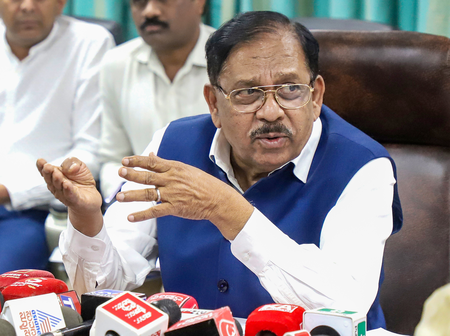
Bengaluru, Sep 21 (IANS) Deputy Chief Minister and Revenue Minister G. Parameshwara on Monday urged the Karnataka Legislative Council to take an objective stand on the Kasturirangan report after discussing its advantages and disadvantages, stressing the need to protect both the environment and the livelihoods of people living in the Western Ghats.
Participating in the discussion, Parameshwara said Karnataka had repeatedly rejected the report, but the Centre kept issuing draft notifications.
“We have to protect the environment while also protecting the interests of people living in the Western Ghats and future generations. The survival of mountain ranges such as the Western Ghats, Eastern Ghats, Aravallis, Vindhyas and the Himalayas is linked to our own survival. At the same time, we must protect the lives and livelihoods of people who have been living there for generations,” he said.
He recalled that the Western Ghats Ecology Expert Panel headed by Madhav Gadgil was constituted by the Union Ministry of Environment and Forests in 2010 under the Environment Protection Act, 1986.
The panel submitted its report on August 30, 2011, identifying 1,29,037 sq km of the Western Ghats and classifying the area into three ecological sensitivity zones.
Following opposition from state governments, local people and elected representatives, the Centre constituted an 11-member High Level Working Group headed by K. Kasturirangan in August 2012 to review the Gadgil committee report.
The group submitted its report on April 15, 2013, recommending around 59,940 sq km across six states as Ecologically Sensitive Areas.
In Karnataka, the Kasturirangan report identified 20,668 sq km as an Ecologically Sensitive Area covering 1,576 villages across 10 districts and 33 taluks, including Belagavi, Uttara Kannada, Shivamogga, Udupi, Chikkamagaluru, Dakshina Kannada, Hassan, Kodagu, Mysuru and Chamarajanagar.
Parameshwara said the recommendations included a ban on new mining, quarrying and sand mining activities, while existing mining leases were to be phased out within five years.
Restrictions were also proposed on new thermal power projects and expansion of certain “red” industries.
The report also proposed restrictions on new large construction projects, townships and area development projects, while permitting new hydropower projects subject to conditions, including a minimum distance of three kilometres between projects.
He said Karnataka had been opposing the report since 2014 because of concerns over its impact on the lives and development of people in the Western Ghats. A Cabinet sub-committee was constituted in 2014 and visited Western Ghats districts during January and February 2015. It held public meetings, collected people’s views, and submitted a report, which the state government accepted and communicated to the Centre.
Parameshwara said the state had subsequently written to the Centre on several occasions opposing the Kasturirangan recommendations and successive draft notifications. He noted that the Centre constituted another committee headed by Sanjay Kumar on April 18, 2022.
The committee visited Karnataka in May that year and was informed of the state’s objections. It is carrying out satellite-based surveys as well as physical verification of residential areas, plantations and agricultural land located amid forests.
According to Parameshwara, the Kasturirangan report had identified 20,668 sq km in Karnataka. After correcting technical errors, the area would come down to 19,252.16 sq km. Of this, 16,114.08 sq km is already covered under national parks, wildlife sanctuaries, reserve forests and other protected categories, leaving 3,108.08 sq km for further consideration.
He said village-wise verification and survey-number-wise mapping should be undertaken to establish the actual ground situation and submit the findings to the Centre.
“We have to protect the Western Ghats as well as the lives of the people who have lived there for thousands of years. If the environment is protected, the lives of the people living there can also be protected,” Parameshwara said, urging the Council to discuss the issue and offer suggestions to help the government take further decisions.
–IANS
mka/dan