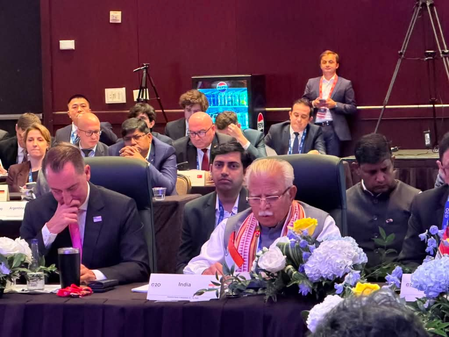
Washington, Sep 21 (IANS) India has joined other G20 members in adopting four consensus outcomes covering household energy access, infrastructure approvals, water reuse and secure critical-mineral supply chains.
The agreements were reached at the conclusion of the three-day G20 Energy Abundance Ministerial in Houston, Texas, according to a White House statement.
The White House National Energy Dominance Council, the departments of Energy and the Interior, and the Environmental Protection Agency hosted the ministerial.
The outcomes advance three stated priorities of the G20 Energy Abundance Working Group: energy security and affordable baseload power, permitting and regulatory efficiency, and resilient critical-mineral supply chains.
On household energy access, ministers backed affordable and scalable approaches tailored to conditions in individual countries.
The statement specifically recognised liquefied petroleum gas as an option for quickly replacing traditional biomass where LPG is reliable and can be expanded at scale. The issue is particularly relevant for developing countries seeking cleaner household cooking fuels.
The second outcome calls for more efficient, predictable and effective domestic permitting and regulatory processes for infrastructure projects.
Ministers also adopted a voluntary water-reuse initiative covering communities, energy production, manufacturing, agriculture and other essential sectors. The initiative promotes approaches designed around the quality and purpose of reused water.
The fourth agreement calls for voluntary cooperation to establish resilient, affordable, secure and diversified critical-mineral value chains.
The proposed cooperation includes information-sharing, innovation, investment, capacity-building and local value addition.
“The world cannot build secure energy systems, advanced manufacturing capacity, or digital infrastructure on fragile mineral supply chains,” US Interior Secretary Doug Burgum said.
“The consensus reached in Houston supports a common-sense approach: diversify supply, strengthen domestic and regional capacity, encourage investment and innovation, and respect each nation’s sovereignty over its natural resources,” he said.
“These steps will help reduce overreliance on any single supplier while creating more durable supply chains and greater economic opportunity,” Burgum added.
US Energy Secretary Chris Wright said the agreements would help expand reliable energy and infrastructure.
“Energy is the essential ingredient that enables everything we do,” Wright said.
“A highly energized society brings health, wealth, and opportunity. The consensus reached in Houston advances cooperation to expand the affordable, reliable, and secure energy, infrastructure, and supply chains needed to support prosperity, resilience, and opportunity throughout the world,” he said.
Several investment and commercial announcements accompanied the ministerial.
Japan’s Hitachi Energy announced a $528 million investment to build a power-transformer manufacturing facility in Gallman, Mississippi. The project is expected to create 654 jobs.
Houston-based Caturus announced a five-train expansion of its Commonwealth LNG export facility in Louisiana. The expansion would add 7.75 million tonnes of annual capacity and nearly double the project’s planned output to about 17.25 million tonnes.
Continental Resources also signed a memorandum of understanding with Venezuela’s state-owned PDVSA to develop and operate the 126,000-acre Ayacucho 2 Block in the Orinoco Belt.
At the meeting, EPA Administrator Lee Zeldin announced the repeal of most greenhouse-gas requirements imposed on American power plants during the Biden administration.
The EPA estimates that the repeal will save $310 billion. It also proposed withdrawing the remaining standards, which the agency said would reduce direct compliance costs by another $370 million. Those figures represent the administration’s projections.
India attended the ministerial alongside the United States, China, Russia, Canada, Australia, Brazil, Indonesia, Japan, South Korea, Saudi Arabia and several European countries. The African Union and European Union were also represented.
G20 ministerial outcomes are consensus-based political commitments, not treaties. Their implementation will depend on the domestic policies, regulations and investment decisions of the participating governments.
For India, the four agreements correspond with policy priorities involving cleaner cooking fuels, domestic infrastructure, water conservation and access to minerals needed for advanced manufacturing, electronics and energy technologies. The commitment to local value addition could also support India’s efforts to expand mineral processing and manufacturing capacity rather than depend entirely on imported finished products.
–IANS
lkj/dan