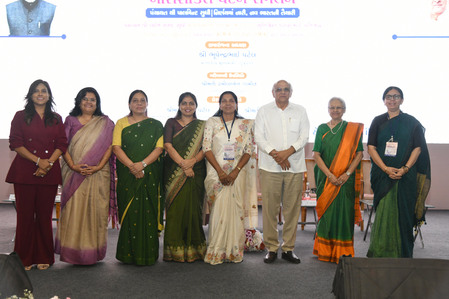
Gandhinagar, April 15 (IANS) The proposed implementation of the ‘Nari Shakti Vandan Adhiniyam’, providing 33 per cent reservation for women in Parliament and state legislatures, formed the central focus of discussions at a state-level conference in Gandhinagar on Wednesday, where Gujarat Chief Minister Bhupendra Patel underlined its significance in strengthening democratic participation and advancing women-led development.
Addressing the bill, Patel said the legislation would ensure structured representation of women from state assemblies to the Parliament, describing it as a key step in India’s democratic evolution.
“The implementation of the bill from state assemblies to Parliament will become a new milestone in the journey towards a developed India through women’s participation,” he said.
He said the increased presence of women in decision-making processes would improve the quality of governance.
“Women’s decisive role in the policy-making process will bring greater sensitivity, transparency and balance to the system of governance,” he added.
Referring to the passage of the legislation in 2023, the Chief Minister described it as a landmark moment in parliamentary history.
“The Nari Shakti Vandan Adhiniyam is not merely a reservation law, but a historic document that brings a revolutionary change in the polity,” he said, adding that the law reflects a long-term institutional shift in representation.
Patel noted that the Prime Minister’s vision had consistently focused on ensuring women’s participation in public life from the grassroots level upwards.
“It is the Prime Minister’s resolve that women are given appropriate opportunities to enter public life from Panchayats to Parliament,” he said.
He also highlighted Gujarat’s earlier decision to implement 50 per cent reservation for women in Panchayati Raj institutions, which, he said, had strengthened local governance and increased grassroots participation.
Outlining the impact of central welfare programmes, Patel said self-help groups had enabled large-scale economic empowerment of women.
“Lakhs of sisters have become self-reliant through self-help groups and have established their identity as micro-entrepreneurs,” he said.
He further referred to schemes such as the Pradhan Mantri Jan Arogya Yojana (PMJAY), Ujjwala Yojana, Namo Drone Didi initiative and Lakhpati Didi programme, stating that these initiatives had contributed to improved healthcare access, livelihoods and financial independence among women.
He said that as a result of welfare interventions, around 25 crore people had been lifted out of poverty.
“Through the mantra of Sabka Saath, Sabka Vikas, Sabka Prayas, women will continue to play a key role in achieving the vision of Viksit Bharat at 2047,” Patel said.
Gandhinagar Mayor Mira Patel said women’s participation in governance and development had expanded significantly across sectors.
“Women are actively contributing in education, health, industry, services, startups and governance, and are playing an important role in the overall progress of the state,” she said, adding that the reservation law would further strengthen their representation in legislative bodies.
Padma Shri awardee Ramilaben Gamit said women’s empowerment was capable of transforming rural society.
“When women are given proper opportunity and encouragement, they can bring revolutionary change in society,” she said, adding that she had established 162 self-help groups that have helped women acquire skills in tailoring, masonry, beauty services and waste management, supporting their financial independence.
Gandhinagar North MLA Rita Patel said women’s involvement in public life was essential for inclusive growth.
“The role of women in the development of society is indispensable,” she said, noting Gujarat’s continued focus on promoting women in education, health and employment.
Usha Jaiswal, Chairperson of the FICCI Women Organisation, Ahmedabad, said women entrepreneurs in India were increasingly emerging as leaders and innovators.
“Women are now moving beyond participation to leadership, and they have the potential to compete at the global level,” she added.
–IANS
mys/uk