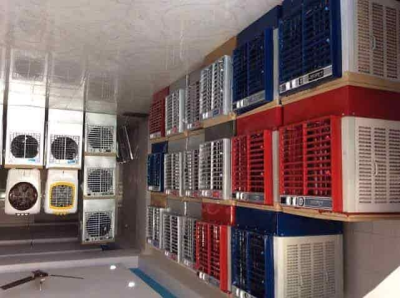
New Delhi, July 29 (IANS) As the West swelters amid severe heatwaves, several media reports have lately been debating the use of air-conditioners (ACs) which was once not really a necessary item to be added in a household, especially in Europe.
India, meanwhile, “is quickly adding AC units” with an additional “some 50m between 2019 and 2024, or half of the total for Europe”, reported The Economist recently.
The India Energy and Climate Centre (IECC) at the University of California in Berkeley, expects the country to add another 130m-150m units over the coming decade, it added.
The report began by describing how early July, with temperatures “set to soar above 40 degree Celsius”, a mob in Nanterre, a Paris suburb, “heaved against the doors of a Lidl supermarket until they collapsed”.
The “mob” was desperate shoppers, trying to buy the last portable AC unit.
In a similar outlet across town, two men came to blows for apparently the same reason, it added.
The Scienceinsights website explains that fewer European houses have air-conditioning than the United States because of historically mild summers, older building designs, high electricity costs, and environmental concerns.
According to it, Europeans also feel heat more intensely than South Asians because their infrastructure, bodies, and daily routines are not adapted to extreme heat, and factors like longer summer days, humidity, and building design amplify discomfort. Thus, the number of AC units in Europe has more than doubled since 1990, as the need for cooling buildings quadrupled, particularly in the north of the continent, said a report in Euronews three years ago.
It quoted a statement by the International Energy Agency (IEA), published in 2018 and based on data from 2016, that found the European Union has far fewer air conditioning units than China or the United States.
Additionally, many European homes were built before AC existed, with thick stone or brick walls providing natural cooling, while US homes, usually framed with wood, heated up quickly.
Also, running an AC in Europe costs 2-3 times more than in the US due to higher energy prices and taxes, discouraging widespread adoption, Scienceinsights added.
The Economist gave further insights.
The COP30 climate summit in Brazil declared cooling technologies “essential infrastructure”, placing them alongside water and sanitation. This recognition stems from the deadly toll of extreme heat.
Between 2000 and 2019, heat killed nearly half a million people annually, found a Lancet Countdown 2025 report.
AC has apparently proven remarkably effective. By the early 2020s, estimated a separate study in the Lancet, it was preventing around 190,000 deaths each year among those aged 65 years or older.
But the political calculus is not straightforward. Expanding AC access raises thorny questions about energy demand, emissions, and inequality. Globally, cooling already accounts for four per cent of greenhouse-gas emissions, and demand is expected to triple by 2050.
The paradox is that AC protects people from climate-driven heat, but its widespread use worsens climate change.
The Economist report deduced that countries that cannot afford to invest in grids, and in AC, risk entering a self-reinforcing spiral.
It referred to a statement from Lee Kuan Yew, Singapore’s founding father, who in 2009 famously cited AC as one of the most influential inventions in history for “making development possible in the tropics”.
Lee’s city-state became rich for a host of other reasons, but AC helped things along, it said.
Meanwhile, an earlier Unicef analysis said that one in five children – around 466 million – live in areas that experience at least double the number of extremely hot days every year compared to just six decades ago.
Heat stress within the body, caused by exposure to extreme heat, poses unique threats to the health and well-being of children and pregnant women, particularly if cooling interventions are not available, it stressed.
Additionally, the International Labour Organisation estimates that by 2030 heat stress will remove 2.2 per cent of the world’s working hours, or equivalent of 80m full-time jobs.
The losses are concentrated among agricultural workers in South Asia and west Africa.
There is yet a strong resistance to switching on the AC to combat rising temperatures with effects being raised on significant rise in electricity demand, releasing potent greenhouse gases, and worsening urban heat islands.
–IANS
jb/khz