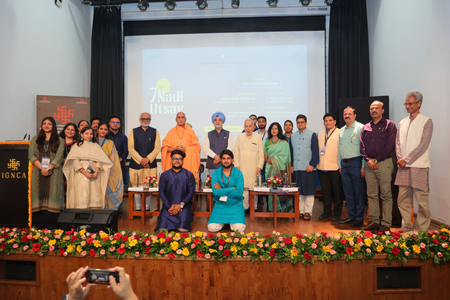
New Delhi, Sep 25 (IANS) Delhi Lieutenant Governor T.S. Sandhu said that the health of the Yamuna cannot be restored by treating the river alone and that addressing what enters it, and how the surrounding cities and communities are managed, is equally essential, an official said on Friday.
Speaking at the 7th Nadi (river) Utsav, organised by the Indira Gandhi National Centre for the Arts (IGNCA), Sandhu pointed to Prime Minister Narendra Modi’s reflection that the continuous flow of rivers teaches how our capabilities can be used for the welfare of humanity, connecting this spirit with selfless service, dedication, and benevolence.
The Lieutenant Governor said a river gives continuously, and it is our responsibility to ensure that our own actions do not break this cycle of giving.
He said this is why the rejuvenation of the Yamuna must be both an environmental mission and a cultural mission, and that institutions such as IGNCA can help reconnect people with rivers through research, exhibitions, films, photography, seminars, and public programmes.
The Lieutenant Governor emphasised that restoring the Yamuna means restoring a living connection between Delhi’s past, present and future, requiring sustained cooperation between government agencies, experts, researchers, cultural institutions, civil society and citizens.
He expressed hope that the three-day festival would deepen awareness, encourage participation and generate ideas for the continuing rejuvenation of the Yamuna.
Others present on the occasion included Spiritual Leader and Author Swami Avdheshanand Giri; President, IGNCA, Ram Bahadur Rai; renowned Kathak danseuse Shovana Narayan; Member Secretary, IGNCA, Sachchidanand Joshi; and scholars, authors and artists.
Sandhu also shared details of efforts currently underway at both the Delhi and national levels, with the Delhi government and the Delhi Jal Board strengthening sewage-treatment infrastructure to prevent untreated wastewater from entering the Yamuna, alongside the national Namami Gange programme, which covers pollution abatement, ecological conservation, biodiversity, afforestation, sanitation and public participation.
He said these efforts recognise an important principle: that the health of a river cannot be restored by treating the river alone and that addressing what enters it, and how the surrounding cities, communities and ecosystems are managed, is equally essential.
Sandhu said Delhi has grown with the Yamuna, which has witnessed the evolution of the city and remains part of its ecological and cultural landscape, but that this relationship today comes with a responsibility, as the river faces considerable pressure from urbanisation, pollution, and the changing relationship between the city and its natural environment.
–IANS
rch/dan