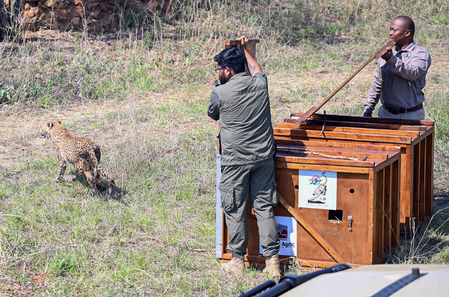
Gwalior, Feb 28 (IANS) A special Indian Air Force (IAF) aircraft carrying eight cheetahs from Botswana arrived at Gwalior airport on Saturday morning. After a formal inspection of the cheetahs which had travelled for over 10 hours, the officials concerned moved the cages carrying the cheetahs into two helicopters. From Gwalior’s airport, these cheetahs were flown to Kuno National Park, located in Sheopur district of the Gwalior-Chambal region in Madhya Pradesh.
Union Environment Minister Bhupendra Yadav will release them at Kuno National Park.
The animals will be released into quarantine enclosures at Kuno National Park in Madhya Pradesh, where officials will closely monitor their health and behaviour before gradually preparing them for life in the wild.
A team of forest veterinarians and wildlife experts has also arrived from Botswana, who will be assisting the forest officials responsible for the success of ‘Project Cheetah’ at Kuno National Park, according to a senior forest official in Madhya Pradesh.
With the arrival of eight new cheetahs, which is part of the Centre’s ambitious cheetah reintroduction programme, the total number of the big cats in the country went up to 47, including 28 cubs born at the park since the first batch of cheetahs were released here on September 17, 2022.
Officials told IANS that multiple quarantine enclosures have been prepared at the park to ensure stress-free transfer of the animals. Under the protocol, the cheetahs will remain in large, fenced enclosures for about a month.
This is the third batch of African cheetahs brought to India under the translocation programme, following earlier introductions from Namibia in September 2022 and South Africa in February 2023.
The latest transfer from Botswana is part of a government-to-government agreement aimed at establishing a genetically diverse, free-ranging cheetah population in India over the next decade.
During the quarantine period, which is likely to be between 15 days to 30 days, wildlife veterinarians and forest officials will monitor their feeding patterns, movement, adaptation to local climate, and any signs of stress or disease.
Blood samples and health parameters will be assessed regularly. The cheetahs will soon be fitted with GPS satellite collars, which will be checked to ensure real-time tracking once the animals are eventually released into larger soft-release areas.
Notably, since 2023, as many as 30 cubs have been born at Kuno, of which 28 (one cub was located on Friday) have survived. This year alone, a total of nine cubs were born in two litters between February 7 and February 18 and all have survived so far.
Official sources told IANS that some cheetahs, including Indian born cubs will be shifted to the Nauradehi Wildlife Sanctuary, which is located in Vindhya Forest range, covering Sagar, Damoh and Narsinghpur districts.
–IANS
pd/rad