Bengaluru, Sep 25 (IANS) Union Education Minister, Pralhad Joshi, on Friday said the National Education Policy (NEP) 2020 places critical thinking, creativity, experimental learning and problem-solving at the centre of education, while highlighting initiatives aimed at encouraging innovation among students from an early age.
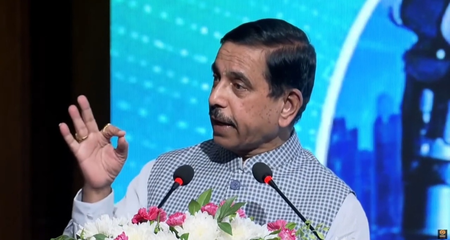
Speaking at the Seva First Innovation Challenge at the Indian Institute of Science (IISc), Bengaluru, Joshi said the objective of the education policy was not merely to prepare students for jobs but to encourage them to think critically, experiment, innovate and find solutions to real-world problems.
Referring to Karnataka, Joshi alleged that the state government had discontinued the implementation of NEP 2020. Karnataka had earlier initiated NEP implementation, but the Congress government subsequently decided to move away from the policy and work towards a State Education Policy to suit regional realities.
Joshi said more than 10,000 Atal Tinkering Labs were currently engaging over 1.1 crore students across the country. Students working through these labs had already created more than 16 lakh innovation projects, he said.
Recalling his visits to schools with Atal Tinkering Labs, Joshi said some schools had kept the laboratories locked because teachers feared that students would damage the equipment.
He said students should be allowed to use the facilities and experiment without fear of damaging equipment, as the objective was to encourage young minds to develop their thinking and critical-thinking abilities.
The minister said the government had announced 50,000 additional Atal Tinkering Labs in schools over the next five years. In higher education, more than 17,300 Institution Innovation Councils have also been established, he said.
Joshi cited several innovations emerging from educational institutions, including Homosap, a robotic septic tank cleaner developed by IIT-Madras, and an Electrolarynx designed to provide a voice to people who have lost their ability to speak.
He also referred to an induction stove developed by NIT-Warangal for copper and aluminium utensils, saying that such innovations, though they may appear small, could address several day-to-day problems faced by ordinary people.
“We should work, we should innovate, we should provide solutions, not only for India, but for the world also. Innovate in India, Make in India, not only for India, for the world also,” Joshi said.
He said more than 65 per cent of India’s population was below the age of 35 and described the country’s young population as an opportunity to drive innovation and development.
Joshi also highlighted efforts to build capacity in frontier technologies, saying four Centres of Excellence in Artificial Intelligence had been established in healthcare, sustainable cities, agriculture and education, with a total outlay of Rs 1,490 crore.
He said the Smart India Hackathon had witnessed participation from more than 18 lakh students, who had worked on nearly 3,158 real-world problem statements submitted by government departments, industry and public institutions.
Referring to the Bharat Innovates event held in Nice, France, Joshi said India had showcased 120 deep-tech startups emerging from higher education institutions.
He said the French Head of State, who had initially allotted 20 minutes to visit the innovation showcase, spent more than an hour interacting with the participants after seeing the innovations.
Joshi said India had subsequently received more than 20 requests to organise similar showcases in countries including Canada and other nations, attributing the interest to growing confidence in Indian young minds and the country’s policy stability.
He said the goal of becoming Viksit Bharat by 2047 was primarily for today’s young generation, who would be the beneficiaries of India’s development in the coming decades.
Joshi also referred to India’s progress in telecommunications, saying 5G technology had been developed in India and 6G technology would also be developed using Indian technology.
He said smartphones manufactured in India were currently designed outside the country, but in the coming years, the aim would be to have phones designed and manufactured in India, while also being sold in domestic and international markets.
–IANS
mka/rad