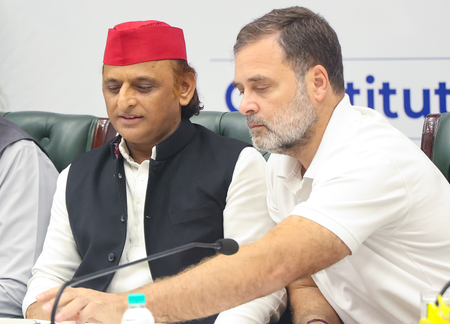
New Delhi, Sep 23 (IANS) The latest exchange between leaders of the Samajwadi Party (SP) and the Congress ahead of the 2027 Uttar Pradesh Assembly election is a reminder of opposition parties making the political contest against the ruling Bharatiya Janata Party (BJP) secondary to the war of attrition within its own ranks.
While the BJP has begun strengthening its organisation and preparing for the high-stakes electoral battle next year, sections among its principal rivals appear preoccupied with settling the question of who should be leading the Opposition.
This is currently the contention between SP MP Iqra Hasan and Congress MP Imran Masood.
Hasan reportedly said that only SP Chief Akhilesh Yadav is capable of defeating the BJP in Uttar Pradesh and suggested that the Congress could achieve little on its own.
Masood is said to have responded by insisting that Lok Sabha Leader of Opposition and Congress leader Rahul Gandhi is the only Opposition leader with a national reach capable of unsettling the BJP.
The signal thus emerging from Uttar Pradesh is that despite repeated assurances from the top leadership of both parties that the alliance remains intact, there is still no consensus on hierarchy, ownership and political primacy within.
That should worry Opposition ranks at this hour.
In the 2024 Lok Sabha election, the SP emerged as the principal beneficiary of the alliance, winning far more seats than the Congress and re-establishing itself as the state’s dominant Opposition force.
Akhilesh Yadav sought to broaden his party’s social coalition with PDA (Pichhda, Dalit, and Alpsankhyak) and provided a coherent political message against the BJP.
It is the principal reason that SP leaders see Akhilesh Yadav, not Rahul Gandhi, as the central face of any challenge in Uttar Pradesh.
But for the Congress, despite the political setbacks, Rahul Gandhi’s national campaign against the ruling National Democratic Alliance (NDA) remains the focus, saying that national visibility and a broader anti-BJP platform that regional parties alone cannot provide.
For a probable alliance platform, the trouble is that rather than discussing it internally, opinions are being aired publicly.
Uttar Pradesh has seen alliances collapse under the weight of leadership ambiguity and seat-sharing disputes.
Yet, the issue of the top face has emerged larger than whether voters believe the coalition’s common purpose.
Before the Bihar Assembly election last year, the Opposition Mahagathbandhan spent months wrestling with questions that should have been resolved early.
There were disputes over seat-sharing between the Rashtriya Janata Dal (RJD) and the Congress, and among other allies, with disagreements over each party’s bargaining power and persistent speculation over leadership arrangements.
Reports at the time highlighted friction between the RJD and Congress as negotiations dragged on and both parties accused each other of being inflexible.
It created the impression that alliance partners were more concerned with protecting their respective egos than presenting a united alternative.
Even when compromises were eventually reached, public memory of the wranglings lingered.
Back in Uttar Pradesh too, seat-sharing remains a sensitive issue.
Congress leaders have pushed for an early settlement, while the SP appears less eager to finalise arrangements.
Congress functionaries have spoken of fighting on equal terms and demanding greater space, while SP leaders have projected confidence in their independent strength.
However, electoral logic strongly favours cooperation.
The Congress is too weak in the state to seriously challenge the BJP on its own, while the SP knows that even a modest Congress vote share can matter in closely fought Assembly constituencies.
Like Bihar, a public spat may not augur well where every spat on who is the “real” Opposition face chips away at voter’s confidence.
The BJP will likely benefit from such utterances.
While Opposition leaders debate credit, the ruling party’s well-oiled electoral machine is preparing early, strengthening organisation and focusing on booth-level mobilisation.
The Opposition needs to have learnt its lesson from Bihar where too much time and animosity now on leadership and seat-sharing may pose a similar risk.
They would do well to remember that elections are rarely won by deciding who gets top billing in the Opposition poster, though these make good debate; rather, won by convincing voters that everyone on that poster is working towards the same goal.
–IANS
jb/khz