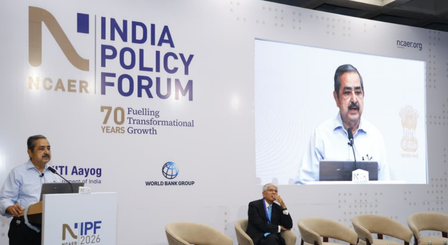
New Delhi, Aug 6 (IANS) The target of making India a developed country by 2047 was achievable, but it would require rapid reforms, NITI Aayog Vice-Chairman Ashok Kumar Lahiri said on Thursday.
Addressing an event organised by the National Council of Applied Economic Research (NCAER), Lahiri said the country would have to achieve a more than 6-fold jump in its per capita income from $2,813 in 2026 to around $18,000 in 2047, which needs an average annual nominal growth of 9.25 per cent for 21 years.
“Others have done it, so can India, but it needs support through rapid reforms,” Lahiri said while citing the examples of Japan, South Korea, Taiwan, Hong Kong, Singapore, and China, which have achieved such high growth levels on their way to becoming fully developed economies.
The NITI Aayog Vice-Chairman pointed out that India’s gross fixed capital formation has stayed below 30 per cent of GDP for most years, compared with 35 per cent or more recorded by East Asian countries. However, India was using capital efficiently, with an incremental capital output ratio (ICOR) of 4.5 to 5, compared with China, he added.
Lahiri further stated that growth depends on absorptive capacity. “An economy does not grow so much because it does not invest enough, but because its dynamism is not strong enough to enable it to apply more investment efficiently,” he observed.
He said that education, health, infrastructure and entrepreneurship, along with administrative reforms, law and order, and a faster justice system, were important long-term growth priorities for India.
Lahiri also said that the savings rate in the Indian economy peaked at 37 per cent in 2007, slipped to 29 per cent in 2020 and recovered to 35 per cent in 2025, but has consistently trailed China by 10 to 15 percentage points. He attributed the shortfall to a persistent current account deficit of $16.5 billion in 2025, contrasting it with surpluses in China, South Korea, and Singapore, and said FDI investment inflows had remained limited relative to those economies.
He identified factor market imperfections in land and capital as major drawbacks and underscored the need for facilitating the easing of doing business at the grassroots level in order to spur investment.
–IANS
sps/vd