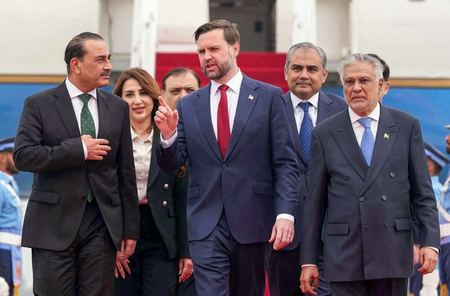
Islamabad, April 15 (IANS) While the recent negotiations between the United States and Iran held in Islamabad failed to deliver the anticipated outcomes, the peace process must move forward through alternative mediation efforts led by major and emerging powers aimed at achieving a sustainable and just peace in the Persian Gulf, a report mentioned.
Citing observers, the report argues that Pakistan’s role in the peace process was more that of a facilitator than a mediator. It added that a mediator nudges the conflicting parties towards common ground by offering a new perspective to better understand and resolve their differences, whereas a facilitator acts as a messenger, exchanging information between the parties to the conflict.
“The United States-Israel war on Iran, which began on February 28, has generated considerable stress in the global economy. As Iran successfully halted the flow of goods and oil through the Strait of Hormuz, many economies around the world experienced energy shocks. While there was considerable loss of life and property in Iran, many Gulf countries also experienced attacks on their civilian establishments and on energy and other economic infrastructure,” an opinion piece in ‘Politeia Research Foundation’ detailed.
“The ceasefire on April 7, 2026, and subsequent peace talks raised hopes for a durable peace in the Persian Gulf. In the global media and in India, there was considerable discussion of Pakistan’s emergence as a platform for negotiations between the US and Iran. It should be noted that the US and Iran chose Pakistan as a facilitator within a specific geopolitical context,” wrote Sanjay Pulipaka, Chairperson of the Politeia Research Foundation.
He mentioned further that, given the Strait of Hormuz’s critical importance to the Indian economy, any potential mediation process by India would be active rather than passive, with a push for open sea lanes benefitting the economies of many developing countries — thereby making New Delhi an unlikely first choice mediator in the current Iran-US conflict.
It was noted that the US appears to be deepening its relationship with Pakistan for several months, possibly to prepare for contingencies arising from a potential conflict with Iran.
The report emphasised that the strains in the transatlantic relationship, the involvement of Gulf countries in the conflict, and Pakistan’s long-standing record of protecting and promoting American interests in the region made Islamabad “a suitable candidate for negotiation”.
Highlighting Pakistani military attacks in Afghanistan that resulted in the deaths of hundreds of civilians, the report noted that due to the war in Iran, Pakistan’s actions in Afghanistan did not receive any international scrutiny.
“There are concerns that the afterglow of the peace talks in Islamabad will overshadow violent Pakistani actions in the neighbourhood,” it highlighted.
–IANS
scor/as